Peptide Vials Guide: Storage Space, Taking Care Of & Use The lyophilizates in vacuum-sealed vials are completely steady to endure 3-5 days at ambient temperature level. Upon invoice, the item should be kept at the advised storage space temperature level of -20 or -80. Specific amino acids imitate weak links in your peptide chain.
Specs For Manufacturing And Quality Control Of Peptides
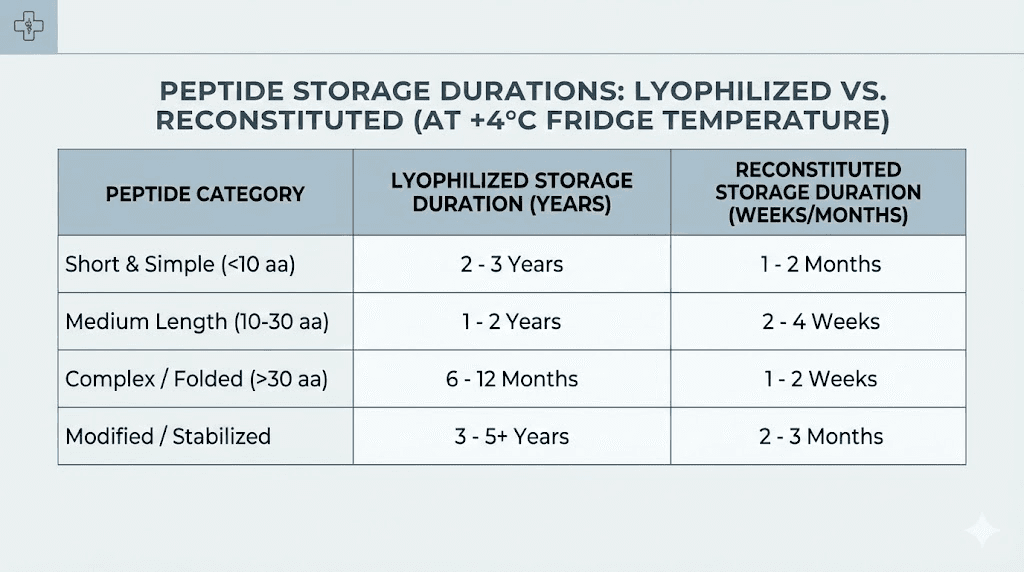
Yes, our benchtop vial loading machine can use both full stoppers and partial stoppers (half-seating). For multi-dose vials ( containing an antimicrobial chemical), the beyond-use date (BUD) after very first leak is 28 days, unless the maker defines or else. For full information regulating the purchase, dealing with, and use of our products, please describe our Conditions. Yet it has to be done thoroughly and with the ideal precautions. Unopened, unpunctured peptide vials can typically be stored at space temperature for a minimal time, depending upon the certain peptide. However, for long-lasting storage, the majority of peptides need to be cooled in between 36 ° F to 46 ° F( 2 ° C to 8 ° C). Once it's time to make use of the peptide, reconstitution is executed to restore the peptide to a functional remedy . Basically, this turns around the freeze-drying procedure by including a details solvent to the dry peptide. Appropriate reconstitution guarantees the peptide completely dissolves without loss of task, so it can perform as expected in experiments. It is an essential action that should be done thoroughly to preserve the peptide's honesty and guarantee consistent results. Reconstituted peptide remedies are generally steady for weeks to months when saved at -20 ° C or -80 ° C in an appropriate, clean and sterile barrier, staying clear of repeated freeze-thaw cycles. The service life of recombinant peptides depends on a selection of elements, including the type of peptide, storage space problems, and whether stabilizers or chemicals are included. Generally, recombinant peptides can stay energetic for weeks to months under appropriate storage space problems (e.g., cooled at 2-8 ° C)
Adding a small amount of weaken acetic acid before diluting with water frequently improves outcomes.
Attracting 0.1 mL of this solution delivers exactly 250mcg of peptide.
Reconstituted peptide remedies are usually stable for weeks to months when kept at -20 ° C or -80 ° C in an appropriate, sterile barrier, preventing duplicated freeze-thaw cycles.
Guidelines have been created by the International Organization forStandardization (ISO 15194), which make sure the quality of manufactured referencematerials.
When a needle punches with rubber inaccurately, it can take a small piece that falls under your service. These particles pollute the peptide and develop shot security issues. Correct technique, which we'll cover soon, lessens this danger. Non-specific adsorption adds to carryover, which increasesvariability and bias because of recurring signal in sample runs (59 ). Carryover in example preparation can originatefrom re-using pipette tips to move peptide options in between vials or indispensing aliquots. One can figure out the level ofnon-specific adsorption by moving a service of the analyte sequentiallyfrom one vial to an additional and assessing a small aliquot after each transfer stepto analyze for losses (60 ). Regardless of thediverse physicochemical residential or commercial properties of peptides, numerous methods can begenerically related to minimize adsorption and cross-contamination sensations( 57, 61) leading to carryover.
What cancels out peptides?
Salicylic acid''s exfoliating action might undercut the peptides, reducing their skin-repairing advantages. Recommendation: To avoid any type of communication, use salicylic acid and peptide items at different times. For example, incorporate salicylic acid in your early morning routine and peptides in your night regimen.
In practical terms, making sure ideal lyophilized peptide storage space problems protects both purity (fewer impurities over time) and effectiveness (higher activity), prolonging valuable service life and staying clear of waste. Amino acid calibrants and peptide/protein QC materials must be selectedcarefully to make certain precision of the dimensions. Calibrants must imitate themeasurand( s) as identically as feasible in both focus and structure/form. Calibrants need to be characterized for purity, both organic and inorganiccontaminants, as well as for water web content. Forisotope-dilution measurements, secure isotope-labeled inner standards mustconsist of matrix- and exact-matched analogs of the target measurand. The declarations and items have actually not been reviewed by the united state Food and Drug Administration and are not meant to identify, treat, cure, or avoid any disease. Truthful Peptide is not an intensifying drug store or chemical compounding facility as defined under section 503A of the Federal Food, Medicine, and Aesthetic Act, neither an outsourcing facility as specified under section 503B. Various deposits deteriorate with different systems. Understanding these pathways clarifies why proper storage space issues.
Sterile Water
All peptides discussed are meant for study functions only and are not for human usage. Peptides are incredibly prone to the damaging effects of light exposure, specifically ultraviolet (UV) radiation, much as vampires https://pharmalabglobal.com/ are afraid of sunlight. Trusted by biotech leaders worldwide for over 45+ years of delivering top quality, quick and scalable artificial biology options. A more powerful solvent made use of for hydrophobic or challenging to liquify peptides. Utilized for harder or hydrophobic peptides to improve solubility. Some solvent systems incorporate bacteriostatic water with 0.9 percent salt chloride, giving both preservative and saline elements. In terms of peptide security, temperature level is among the significant determinants. Peptides are as fragile as snowflakes due to the fact that their native additional frameworks remain stable in the chilly, however they merely crumble and melt with warm. Peptide storage at heats can cause biological ramifications such as architectural changes, loss of activity, or perhaps coming to be damaging.